Introduction
Purpose & Scope
In 2020, I graduated with a Bachelor’s in Social Science from Portland State University. After graduating, I took some time to reflect on my strengths, weaknesses, and the kinds of work I truly enjoy. During this period, I discovered the world of archives. I quickly fell in love with the work of preserving and caring for history so that future generations can learn from it, be inspired by it, and use it to build their own futures.
Over the past three years at San José State University (SJSU), I have worked toward my Master’s in Library and Information Science (MLIS). This e-Portfolio is the culmination of that work. My studies have included asset and preservation management, metadata schemas, and film preservation, along with the creation of a variety of projects such as finding aids, grant funding guides, and video essays exploring historical topics.
I also spent a year interning at the Oregon Jewish Museum and Center for Holocaust Education, where I gained valuable experience with digital asset management software (FileMaker Pro and QI), digitization of photographic records, metadata creation, and building hierarchical structures from the ground up. In my last term, I was able to balance my capstone project, final class, and a full-time internship as the Creative Asset Management Intern at Universal Creative. In the future, I hope to use the skills and knowledge gained through my internships and the MLIS program to contribute to the preservation and asset management efforts of entertainment companies such as The Walt Disney Company, Universal Studios, and Warner Bros.
Framework & Approach
This e-Portfolio serves as both a demonstration of the work and skills I have developed at SJSU and an opportunity to reflect on my progress. The evidence presented synthesizes learning from coursework, professional experiences, and LIS theory.
The MLIS program at SJSU is built around 14 core competencies that students are expected to master by graduation. This e-Portfolio follows that same structure and is composed of an introduction, main body, conclusion, and statement of affirmation. The main body is divided into 14 subsections, one for each core competency. In each subsection, I provide a written rationale demonstrating my understanding of the competency, justify the evidence I selected, and reflect on how the coursework or professional experience connects to LIS practice.
This portfolio is a curated selection, not a comprehensive record of my work or experiences. Each piece of evidence was chosen with intention, reflecting both its relevance and its ability to demonstrate competency mastery. The e-Portfolio was initially created in Canvas, with evidence hyperlinked to Google Drive and accompanied by descriptive labels for each artifact.
Methodology
In INFO 203: Online Learning – Tools and Strategies for Success, incoming students were provided with a Student Success Planner to track coursework and experiences and to assist in developing this e-Portfolio. I used this tool throughout the program to log assignments and related competencies. In the final planning stages, I transitioned to a custom spreadsheet to finalize my evidence selections.
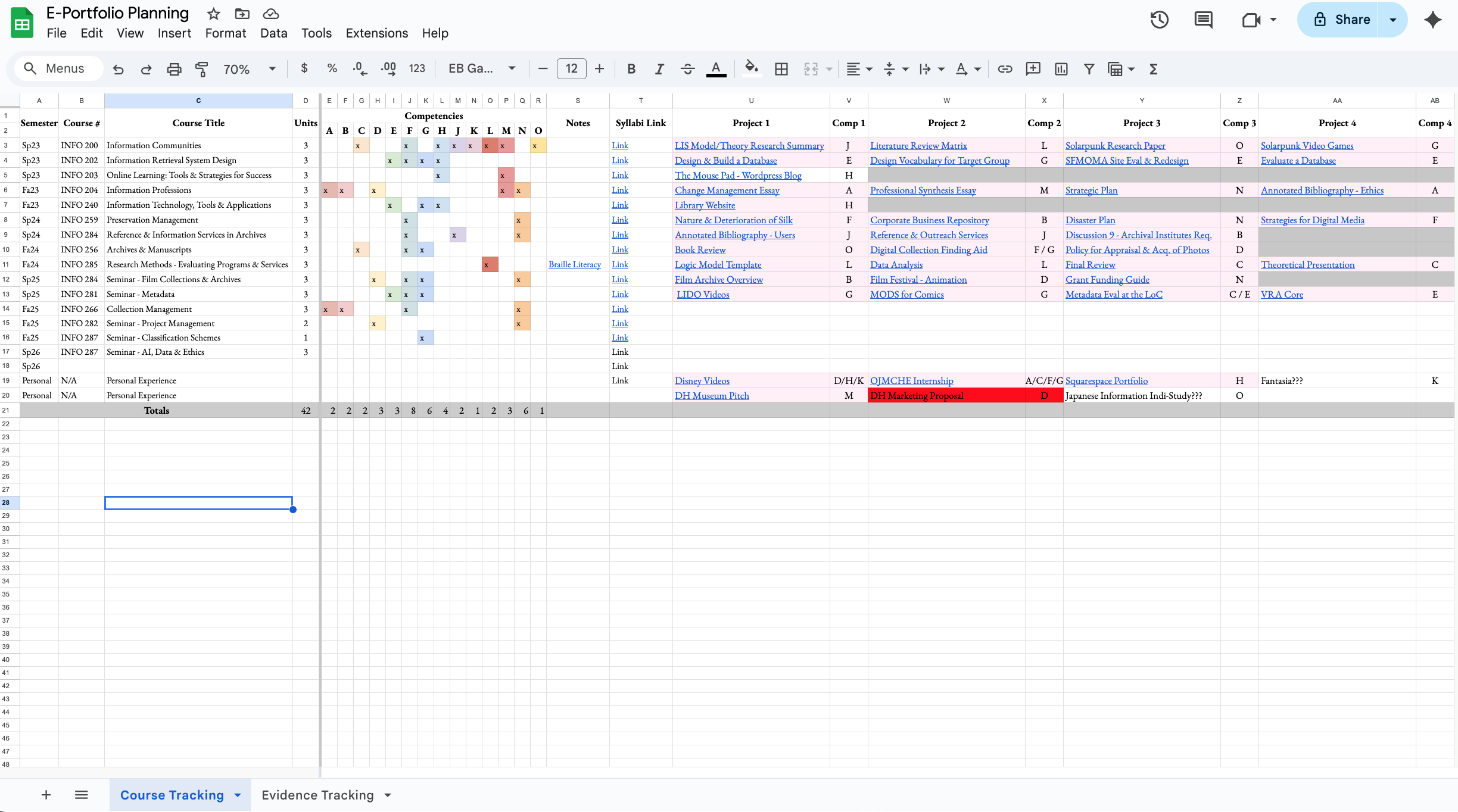
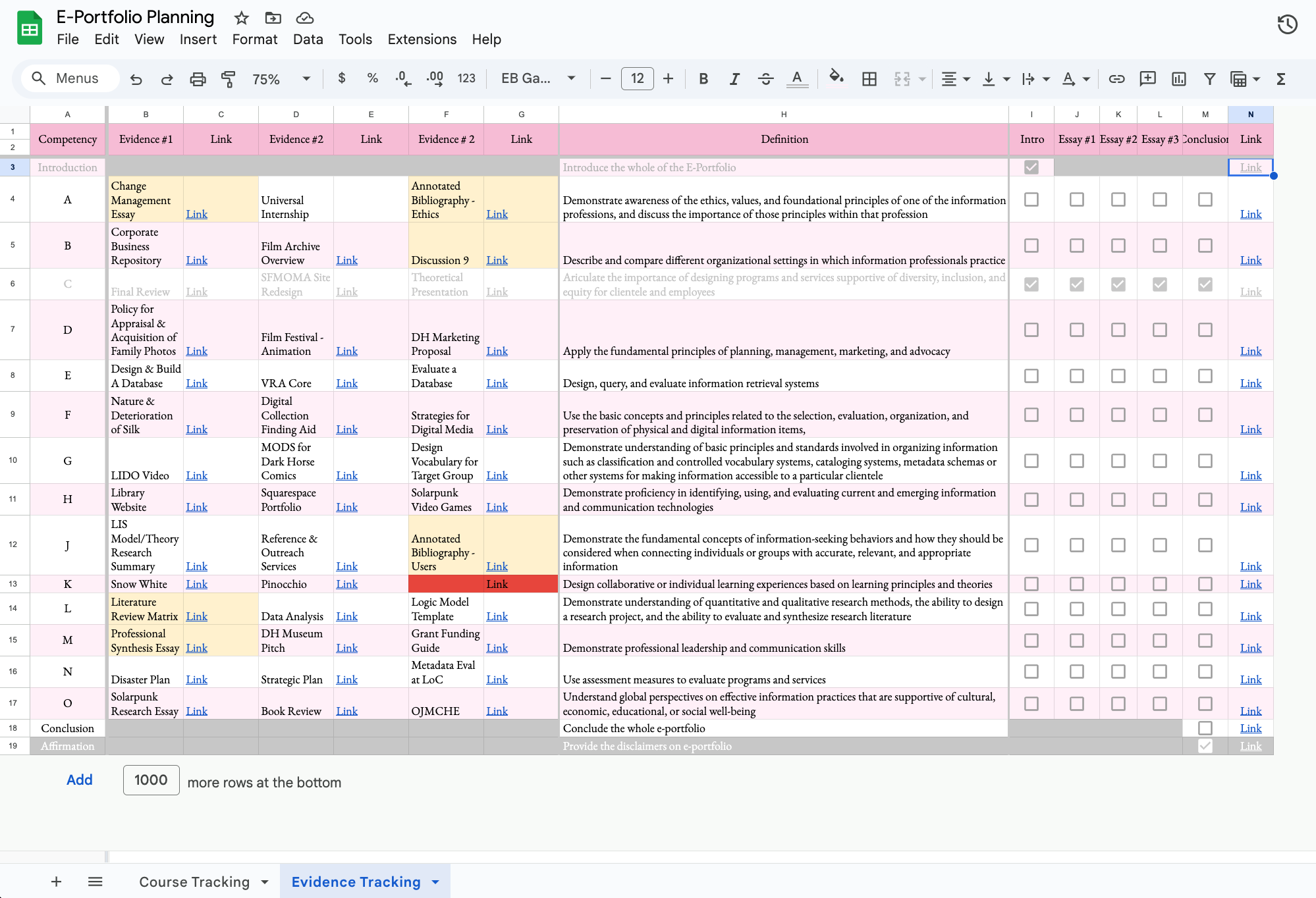
I also downloaded course syllabi for each class from the SJSU website and maintained both hard drive and Google Drive folders to store all coursework, organized by term and then by individual class. This system made locating evidence for the e-Portfolio straightforward.
